How Mere Exposure Effect Shapes Web Design Decisions

- Published on
How Mere Exposure Effect Shapes Web Design Decisions
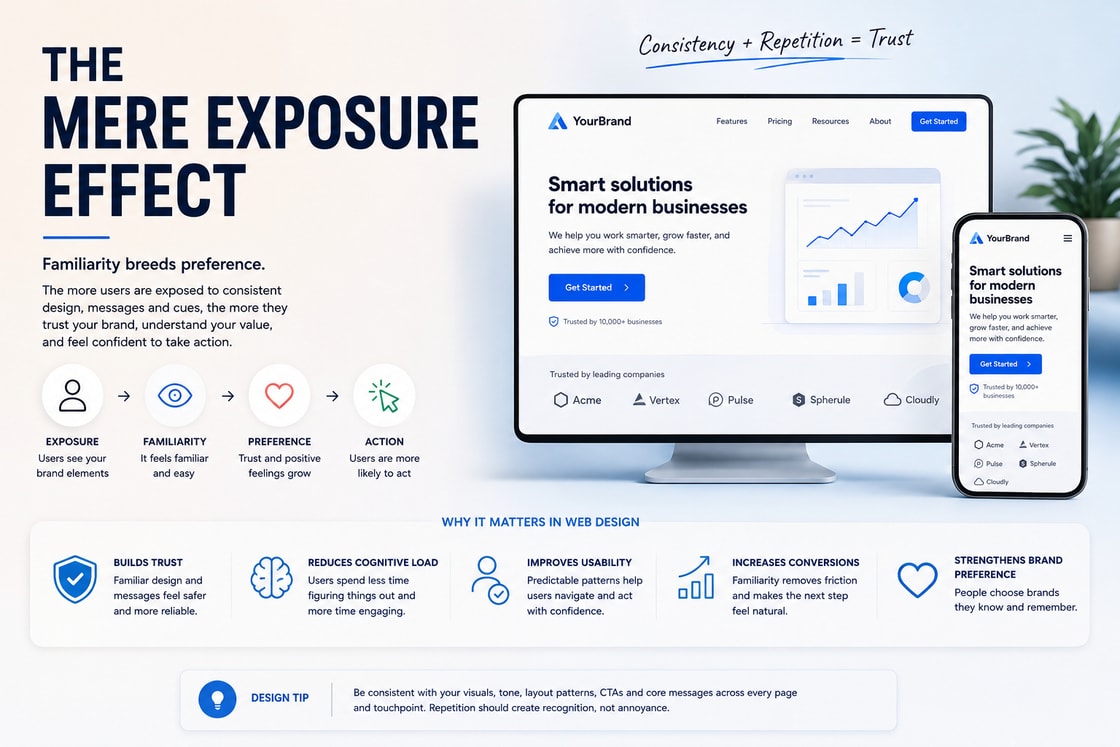
Mere Exposure Effect is one of the most important psychological principles in behavioural web design. It explains why people often develop greater comfort, preference, and trust towards something simply because they have encountered it before.
In simple terms, familiarity changes perception.
A user may not consciously think, “I have seen this brand element before, therefore I trust this website more.” Yet their behaviour often reflects exactly that. Familiar colours, repeated messages, consistent layouts, recognisable calls to action, predictable navigation, and repeated proof signals all reduce uncertainty. The website starts to feel easier to understand because the user does not have to process everything as new.
This is why Mere Exposure Effect matters so much in modern web design. A website is not judged only by what it says. It is judged by how familiar, coherent, safe, and easy the experience feels.
The strongest websites do not rely on visual polish alone. They use repeated cues, consistent design patterns, recognisable language, and carefully placed trust signals to make decision making feel natural.
What Mere Exposure Effect means
Mere Exposure Effect describes the tendency for people to develop a preference for things they have been exposed to repeatedly. The more familiar something feels, the less mental resistance it usually creates.
In behavioural web design, this does not mean that users will automatically like a bad website just because they see it often. Repetition only helps when the exposure is clear, relevant, and not annoying. If a user repeatedly sees a confusing message, a broken layout, or an aggressive popup, familiarity can increase frustration rather than trust.
Good exposure builds comfort.
Bad exposure builds resistance.
This distinction is important. Mere Exposure Effect works best when the repeated experience is stable, useful, and emotionally neutral or positive. The user should feel, “I understand this,” not “I am being chased by this.”
On a website, Mere Exposure Effect can appear through:
Repeated brand colours.
Consistent typography.
Familiar button styles.
Repeated value proposition language.
Recurring trust signals.
Similar section structures across pages.
Predictable navigation.
Repeated product visuals.
Consistent tone of voice.
Familiar calls to action.
When these cues appear consistently, users process the website with less effort. The brand starts to feel more familiar, even if the user has only interacted with it for a short time.
Why Mere Exposure Effect matters on a website
A website has a very small window to make the next action feel clear. Users arrive with limited attention, existing expectations, and some level of uncertainty. They are asking silent questions before they decide whether to stay.
Have I seen something like this before?
Does this feel familiar or strange?
Can I understand what this company does?
Does this look trustworthy?
Do I know what to do next?
Is this worth my time?
Mere Exposure Effect helps because familiarity lowers the perceived effort of continuing. When a page feels consistent, users spend less energy decoding the interface and more energy understanding the offer.
A familiar layout helps users scan faster.
A familiar button style helps users recognise the next step.
A repeated brand message helps users remember the main promise.
A consistent visual system helps users feel that the company is organised.
A repeated proof signal helps claims feel more credible.
This is why consistency is not just a design preference. It is a psychological advantage.
The business psychology point of view
From a business psychology point of view, Mere Exposure Effect is connected to trust, risk perception, decision confidence, and brand preference.
People do not make buying decisions through logic alone. Even in B2B, where decisions appear more rational, buyers still respond to familiarity. A familiar brand feels less risky. A familiar message feels easier to process. A familiar interface feels safer to use.
This matters because most website visitors are not ready to buy immediately. They may compare options, return later, check social proof, ask internally, or move between several pages before taking action. During that journey, repeated exposure shapes how they feel about the brand.
A user who repeatedly sees the same clear promise, the same visual identity, the same proof points, and the same tone begins to form a mental shortcut.
“This company is consistent.”
“This offer is clear.”
“I understand what they do.”
“I have seen enough to consider them.”
That mental shortcut is valuable because uncertainty is one of the biggest barriers to conversion.
In business psychology, familiarity supports three major commercial outcomes.
Trust formation.
Reduced perceived risk.
Easier decision recall.
A website that uses Mere Exposure Effect well does not simply look consistent. It makes the business easier to remember, easier to understand, and easier to choose.
Familiarity reduces cognitive load
Cognitive load refers to the mental effort required to process information. A website with too many new patterns, inconsistent layouts, changing button styles, mixed messages, and unpredictable navigation increases cognitive load.
The user has to keep learning the page.
That creates friction.
Mere Exposure Effect helps reduce that friction by making the experience feel recognisable. Once users learn a pattern, they can reuse that understanding across the website.
For example:
If every service page follows a similar structure, users can compare services faster.
If every call to action uses the same design language, users recognise the next step faster.
If every pricing card follows the same format, users compare value faster.
If every case study presents results in a familiar way, users understand proof faster.
If every form uses the same field logic, users complete it with less hesitation.
The result is not just a cleaner website. The result is a website that feels easier to use.
Familiarity builds brand trust
Trust is not built only by testimonials, awards, or security badges. Trust is also built through consistency.
A brand that looks different on every page feels unstable. A brand that changes its message too often feels unclear. A website that uses different button styles, inconsistent colours, random spacing, and mixed tone of voice can make users feel that the business lacks discipline.
Even if the product is strong, inconsistency creates doubt.
Mere Exposure Effect helps by making the brand feel stable. When users repeatedly see the same identity, promise, and design logic, they begin to feel that the business knows what it is doing.
This is especially important for:
Agencies.
Consultants.
SaaS companies.
Financial services.
Health and wellness businesses.
Education providers.
Legal and professional services.
Ecommerce brands with high value products.
In these categories, users are not only buying a product or service. They are making a trust decision. Familiarity can reduce the emotional distance between hesitation and action.
Familiarity improves conversion confidence
Conversion is rarely caused by one button. It is usually the result of several confidence signals working together.
Before a user takes action, they usually need to believe:
This is relevant to me.
This company understands my problem.
This offer has value.
Other people trust it.
I know what will happen next.
The risk feels acceptable.
Mere Exposure Effect supports this process by repeating important signals at the right moments.
For example, a service page may repeat the same core promise in the hero, the process section, the case study section, and the final call to action. This does not mean copy should be duplicated word for word. It means the same strategic message should appear in different useful forms.
The first exposure creates awareness.
The second exposure creates recognition.
The third exposure creates confidence.
The fourth exposure can support action.
This is why repeated cues matter. A user may ignore a claim the first time, notice it the second time, understand it the third time, and act on it later when it appears next to proof.
How Mere Exposure Effect appears in web design
Mere Exposure Effect appears across many parts of a website. It is not limited to branding. It affects layout, copy, navigation, forms, product pages, and conversion journeys.
Brand identity
Brand identity is one of the clearest uses of Mere Exposure Effect. Colours, typography, icons, imagery, and layout style should feel consistent enough that users recognise the brand across pages.
A strong brand system makes the website feel familiar even when users move to a new page.
This does not mean every page should look identical. It means every page should feel like it belongs to the same business.
Navigation
Navigation becomes easier when users see the same structure repeatedly. If the menu changes too much between pages, users lose confidence.
A predictable navigation system helps users build a mental map of the website. They understand where services live, where resources are, how to contact the business, and how to return to key pages.
This familiarity reduces friction and increases control.
Calls to action
Calls to action benefit heavily from familiarity. If the primary action looks different in every section, users may not instantly recognise what matters.
A consistent call to action style helps users identify the main action without overthinking.
For example, a website might consistently use:
One visual style for the primary action.
A quieter style for secondary actions.
Similar wording for high intent actions.
Repeated reassurance near important buttons.
This makes the action feel familiar, not forced.
Page structure
A repeated page structure can make a website easier to use. This is especially useful for service pages, product pages, case studies, location pages, and resource pages.
For example, service pages can follow a familiar rhythm:
Problem.
Outcome.
Process.
Proof.
Pricing or scope.
Frequently asked questions.
Call to action.
Once users understand the structure, they can move through other pages more confidently.
Content and messaging
Messaging becomes stronger when the same core idea is repeated with purpose.
A business should not say ten different things in ten different ways. It should have a clear central promise and reinforce it through examples, proof, benefits, and calls to action.
This helps users remember the brand.
A weak website makes users ask, “What do they actually do?”
A strong website makes users think, “I understand exactly why this matters.”
Trust signals
Trust signals become more powerful when they appear repeatedly at relevant points. Logos, testimonials, results, awards, ratings, case studies, guarantees, and security reassurance should not be buried in one isolated section.
They should appear near moments of doubt.
For example:
Place client logos near the first major claim.
Place testimonials near the service they support.
Place security reassurance near signup forms.
Place refund or cancellation reassurance near payment actions.
Place case study outcomes near performance claims.
The more naturally users encounter proof, the more familiar and credible the business feels.
How Mere Exposure Effect shapes attention
Users pay more attention to things that feel recognisable. Familiarity creates a sense of fluency. Fluency means the user can process something more easily.
A familiar design pattern feels easier to understand.
A familiar icon feels quicker to interpret.
A familiar content structure feels simpler to scan.
A familiar brand message feels more memorable.
This is why novelty should be used carefully. A website does not need to reinvent every interaction. In many cases, familiar patterns perform better because users already know how they work.
For example, users expect:
A logo to take them to the homepage.
A contact link to appear in the main navigation.
A primary button to lead to the next important action.
Form labels to sit near form fields.
Pricing details to appear near plan benefits.
Reviews to support trust.
Frequently asked questions to answer hesitation.
Breaking these expectations can create confusion. Creative design is valuable, but only when it does not make the user relearn basic behaviour.
How Mere Exposure Effect supports usability
Usability improves when users can predict how the website works. Familiarity creates predictability.
A user should not have to wonder whether a button is clickable. They should not have to relearn the page structure every time they move to a new section. They should not have to decode new design rules on every page.
Mere Exposure Effect supports usability by reinforcing consistent patterns.
This is useful in:
Forms.
Navigation.
Pricing tables.
Product filters.
Booking flows.
Checkout pages.
Dashboard interfaces.
Blog layouts.
Service page templates.
Case study pages.
The more familiar the system becomes, the easier it is for users to move through it.
How Mere Exposure Effect affects pricing decisions
Pricing decisions are high friction because they involve comparison, risk, and commitment.
Mere Exposure Effect can reduce that friction by making pricing information easier to understand and revisit. Users may not choose a plan the first time they see it. They may scroll, compare, return, and review the details again.
A familiar pricing structure helps them do that faster.
Good pricing design should repeat:
Plan names.
Ideal customer types.
Core differences.
Main benefit of each plan.
Pricing logic.
Reassurance.
Call to action.
If users repeatedly see the same plan logic across the page, they become more confident in the choice. If the pricing page introduces new labels, new terms, and inconsistent benefit explanations, users hesitate.
Familiarity makes comparison easier.
How Mere Exposure Effect affects forms
Forms are moments of commitment. Even a simple form can create hesitation if the user does not know what information is needed, why it is needed, or what happens after submission.
Mere Exposure Effect helps forms by making the interaction predictable.
Useful form patterns include:
Consistent label placement.
Familiar input styling.
Clear progress indicators.
Repeated reassurance.
Similar button language across the site.
Short explanations before sensitive fields.
A familiar success message style.
For example, if the website has already used the phrase “Book a strategy call” several times, the final form should not suddenly say “Submit enquiry request.” That change may seem small, but it can interrupt recognition.
The user should feel that the action they are taking is the same action they were prepared for.
How Mere Exposure Effect works across the customer journey
A website is rarely the only exposure point. Users may see the brand through search results, social media, ads, emails, referral links, videos, reviews, and direct visits.
Mere Exposure Effect becomes more powerful when the brand feels consistent across all these touchpoints.
For example:
A user sees a LinkedIn post about a specific problem.
Later, they see a search result using similar language.
They click through to a landing page with the same promise.
They see a case study that reinforces the claim.
They return later and recognise the brand.
They finally complete the form because the business feels familiar.
This is business psychology in action. The user is not responding to one page alone. They are responding to accumulated familiarity.
A strong website should therefore connect with the wider brand ecosystem. The message should not feel disconnected from emails, social posts, ads, sales decks, or client conversations.
Tips and tricks to use Mere Exposure Effect in web design
Repeat the main promise with variation
Do not rely on one hero headline to carry the entire page. Repeat the core promise in different useful ways.
For example:
Hero headline states the main outcome.
Benefit section explains what the outcome means.
Case study proves the outcome is possible.
Final call to action reminds the user of the same outcome.
The message should feel consistent, not copied.
Keep primary buttons visually consistent
Use one clear style for the main action. If every section uses different button colours, shapes, and labels, users lose the visual shortcut.
The primary button should become familiar as the user moves through the page.
Use familiar layouts for high friction tasks
Do not make users learn unusual layouts when they are trying to compare pricing, complete a form, book a call, or buy something.
High friction tasks need clarity more than novelty.
Place repeated proof near repeated claims
If a claim appears more than once, proof should appear near it more than once as well.
For example, if a service page repeatedly claims expertise in a sector, show relevant proof throughout the page, not only at the bottom.
Keep terminology stable
If you call something a “strategy call” in the hero, do not call it a “consultation,” “discovery session,” and “growth audit” in later sections unless there is a clear reason.
Changing terminology weakens familiarity.
Stable language increases confidence.
Use recurring visual cues
Icons, section labels, cards, testimonial blocks, and trust badges should follow a recognisable design system. Users should feel that they understand the page language.
This helps the website feel organised.
Use remarketing carefully
Repeated exposure through ads can support brand recall, but overexposure can create irritation. The same applies to popups, sticky bars, and repeated banners.
Familiarity should feel helpful, not intrusive.
Reinforce the next step
If the main action is to book a call, the page should repeatedly prepare users for that action.
Tell them:
What the call is for.
How long it takes.
What they will discuss.
Who it is suitable for.
What happens after booking.
By the time the button appears, the action should feel familiar.
Use consistency across templates
If your service pages, product pages, and case studies all follow completely different structures, users have to keep adapting.
Templates are not lazy design. Good templates create familiarity, reduce cognitive load, and help users compare options.
Repeat reassurance at decision points
Do not put reassurance only once.
If users may hesitate near a form, place privacy reassurance there. If users may hesitate near pricing, place cancellation or support reassurance there. If users may hesitate near booking, explain what happens next.
Reassurance works best when it appears at the moment of doubt.
Practical examples
Example 1: SaaS website
A SaaS website may use Mere Exposure Effect by repeating the product promise across the journey.
The hero might say that the product helps teams manage client projects faster. The feature section then shows project tracking, approvals, and reporting. The case study shows a team reducing delays. The call to action says “Start managing projects faster.”
The repeated idea is speed and control.
The user sees it in the headline, features, proof, and action. By the time they reach the signup button, the value feels familiar.
Example 2: Agency website
An agency might specialise in SEO for a specific industry. If the website says this once and then moves into generic agency language, the message weakens.
A better approach is to repeat the specialism across the page.
Hero promise focused on the industry.
Service sections using industry language.
Case studies from the same sector.
Testimonials from similar clients.
Frequently asked questions about sector specific challenges.
Call to action that reinforces the same positioning.
This creates familiarity and makes the agency easier to remember.
Example 3: Ecommerce product page
An ecommerce page can use familiarity by repeating key buying reassurances near decision points.
For example:
Free delivery shown near the price.
Return policy shown near the purchase button.
Reviews shown near product claims.
Product benefits repeated in image captions.
Payment reassurance near checkout.
This helps the user feel that the purchase is understandable and low risk.
Example 4: Course landing page
A course page can repeat the learning outcome across the journey.
The hero explains the result. The curriculum shows how the result is achieved. Testimonials prove the result is realistic. The instructor bio reinforces credibility. The final call to action repeats the same learning promise.
The user does not have to remember everything. The page keeps reinforcing the same decision logic.
Common mistakes
Repeating too much
Repetition is useful only when it helps the user. Repeating the same line too often can feel lazy or aggressive.
Good repetition reinforces. Bad repetition annoys.
Changing the main message too often
Many websites try to say everything. This weakens memory.
If one section says the business is fast, another says it is affordable, another says it is premium, and another says it is innovative, the user may not remember anything clearly.
A strong website chooses a central message and supports it.
Using inconsistent calls to action
A page may start with “Book a Call,” then use “Get Started,” then “Contact Us,” then “Submit,” then “Request Information.”
Each phrase may be acceptable in isolation, but together they create uncertainty.
Users should know whether these actions are the same or different.
Making every page look unrelated
Creative variety can be useful, but every page should still feel connected to the same brand.
If a user opens three pages and each one feels like a different company, familiarity is lost.
Overusing popups and banners
Repeated exposure is not permission to interrupt users constantly. If a popup appears too often, it may train users to dislike the brand.
Exposure should create comfort, not fatigue.
Assuming familiarity replaces clarity
A familiar brand still needs clear copy, useful proof, and a good offer. Mere Exposure Effect can support trust, but it cannot fix a weak value proposition.
How to audit a website for Mere Exposure Effect
A practical audit can reveal whether the website is building familiarity or creating confusion.
Review the website and ask:
Is the main promise repeated clearly across key pages?
Do primary buttons look and sound consistent?
Does the visual identity feel stable?
Do service pages follow a recognisable structure?
Are trust signals repeated near important claims?
Does the navigation stay predictable?
Are the same terms used for the same actions?
Does the mobile experience preserve the same familiarity?
Do emails, ads, and landing pages use similar language?
Would a returning visitor instantly recognise the brand?
If the answer is no, the website may be losing the psychological benefit of familiarity.
How to use Mere Exposure Effect ethically
Mere Exposure Effect should not be used to pressure users into decisions they do not want to make. In ethical behavioural design, the aim is to make useful decisions easier, not to trap people.
The principle should be used to:
Reduce confusion.
Improve recognition.
Make navigation easier.
Strengthen trust.
Clarify the next step.
Help users remember the offer.
Support informed decisions.
It should not be used to overwhelm users with repeated popups, forced urgency, misleading ads, or manipulative retargeting.
Good behavioural design respects the user.
Practical takeaway
Mere Exposure Effect shows that familiarity is not a small branding detail. It is a behavioural force that shapes attention, trust, usability, and conversion.
When users repeatedly encounter clear, consistent, and relevant cues, the website becomes easier to understand. The brand becomes easier to remember. The action becomes easier to take.
A strong website does not make every section feel new. It creates a familiar rhythm that helps users move from awareness to understanding, from understanding to trust, and from trust to action.
Before publishing an important page, ask three questions.
What should the user remember after leaving this page?
Where is that message repeated with purpose?
Does every repeated cue make the decision easier?
If the answer is unclear, the website may be asking users to work too hard.
Design checklist
Repeat the main promise across the page in useful ways.
Keep primary button styling consistent.
Use the same terminology for the same action.
Keep page templates familiar across similar content types.
Place trust signals near important claims.
Repeat reassurance near high friction moments.
Use familiar design patterns for forms, pricing, and checkout.
Keep brand colours, typography, and icon styles consistent.
Make navigation predictable across the site.
Avoid repeating popups or banners so often that they create irritation.
Align landing pages with ads, emails, and social posts.
Use repeated proof to support repeated claims.
Test whether users remember the main message after scanning the page.
Check whether returning users can recognise the brand instantly.
Make familiarity support clarity, not replace it.
Mere Exposure Effect is not just a psychology term. In behavioural web design, it becomes a practical lens for deciding what users notice, how they interpret a page, and whether they feel confident enough to continue. The strongest websites do not rely on visual polish alone. They use structure, sequencing, contrast, and context to make decision making feel natural.
What the principle means
At its core, mere exposure effect explains why people do not read and judge a page as a neutral machine would. They scan for patterns, compare what is near, familiar, prominent, or easy, and then decide whether the page deserves more attention. In web design, the principle matters because the interface is often judged before the offer is fully understood.
Why it matters on a website
A website has only a small window to make the next action feel clear. When mere exposure effect is respected, the page feels more coherent, less mentally expensive, and more trustworthy. When it is ignored, users may hesitate, miss the intended path, or assume the page is harder to use than it really is.
How to apply it
Use the principle to guide layout, hierarchy, copy order, button placement, form design, product comparison, and the rhythm of the page. The aim is not to manipulate the user. The aim is to remove unnecessary friction so the intended decision becomes easier to understand.
Common mistake
The common mistake is treating the principle as decoration rather than structure. A page can look polished and still create confusion if the visual relationships, content sequence, or decision cues are weak. Good behavioural design makes the correct next step feel obvious without making the page feel forced.
Practical takeaway
Before publishing a page, ask what the user will notice first, what they will compare next, and what confidence they need before taking action. If the answer is unclear, the design is asking the visitor to do too much cognitive work.
Design checklist
Make the first visible cue support the main purpose of the page.
Keep related content, proof, and calls to action close enough to feel connected.
Remove choices that compete with the user’s most likely next decision.
Use spacing, order, and contrast to reduce unnecessary interpretation.
Test the page by asking whether a new visitor can explain the next step in five seconds.