Psychology of Persuasion in Marketing 5 Proven Behavioural Science Plays With Real Case Studies

- Published on
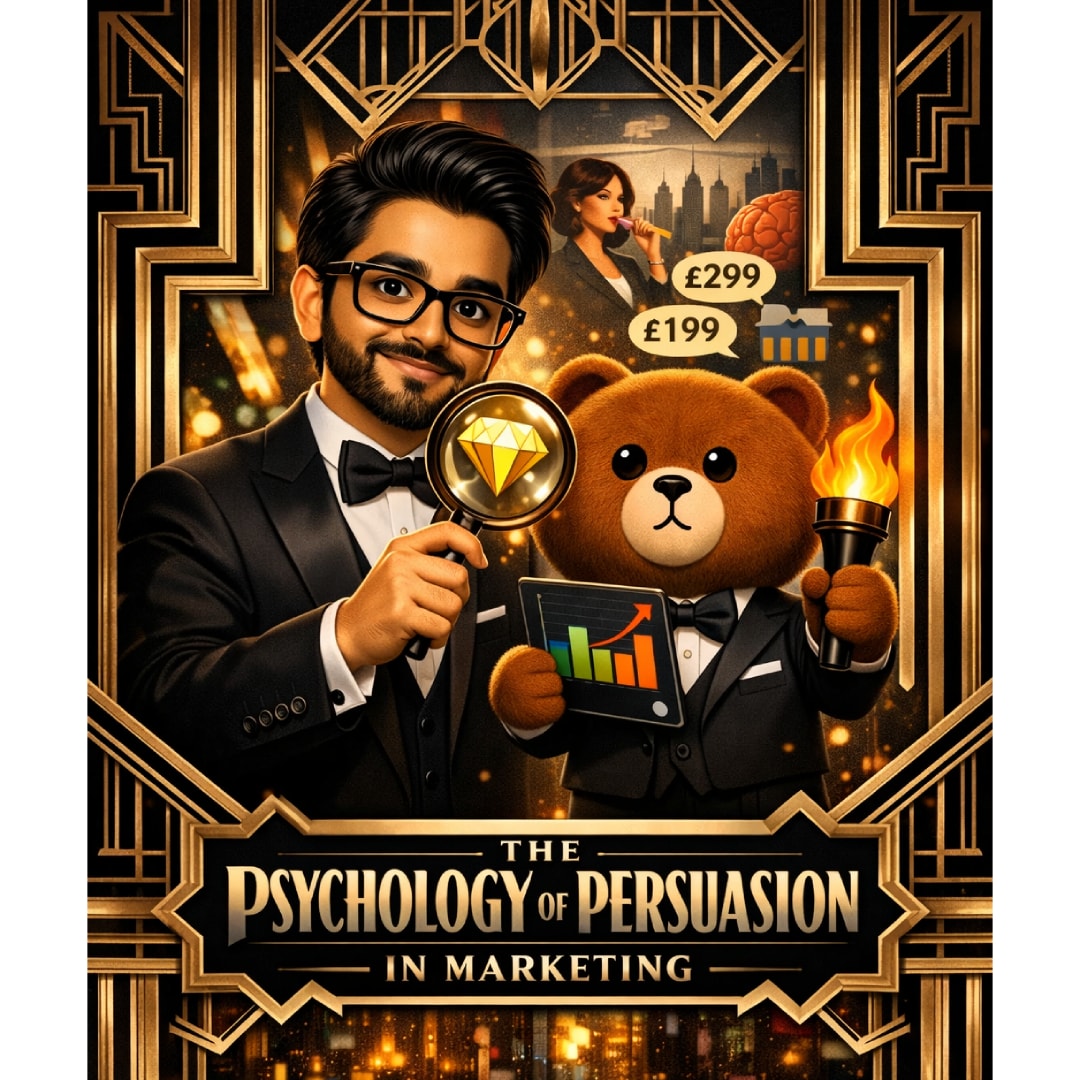
Psychology of Persuasion in Marketing
If you want to persuade people, stop asking:
How do I convince them?
Start asking:
What does their brain do when it is rushed, uncertain, distracted, or trying to avoid regret?
Because most buying decisions are not a courtroom debate. They are a quick judgement call made under limited attention.
Below are five persuasion plays I actually trust, because they show up in classic research and real world marketing.
Each section includes:
- the psychology
- a proper case study
- what to copy in your marketing, design, and analytics
1. Make the behaviour mean something
The psychology
People do not only buy utility. They buy identity, belonging, and permission.
This is why symbolic positioning works. You attach the product to a desire that already exists, then the product feels like a shortcut to that desire.
Case study: Torches of Freedom, 1929
Edward Bernays helped stage an event during the New York Easter Parade where women smoked in public and press coverage framed cigarettes as a symbol of emancipation. The phrase Torches of Freedom was used to connect smoking with liberation, not tobacco.
One summary of the wider market shift reports women bought about 5 percent of cigarettes in 1923, 12 percent in 1929, 18.1 percent in 1935, and 33.3 percent by 1965. That rise is not caused by one stunt alone, but it shows how fast a taboo can move once the behaviour is given a new social meaning.
How you use this now
Think in terms of identity statements, not features.
A feature says: encrypted file transfer.
A meaning says: control, privacy, status, peace of mind.
In practice:
- Pick the desire you want to borrow. Control, prestige, safety, freedom, competence.
- Build the narrative around that desire.
- Make your creative show the identity, not the product.
Analytics tip: track whether identity led messaging changes conversion rate more than feature led messaging. Use one clean landing page test with only the hero, subhead, and primary visual changed.
2. Reduce choice or you will reduce action
The psychology
When choice feels heavy, people delay, quit, or pick nothing. This is choice overload.
It is not that humans hate choice. It is that too many options increase effort and the brain avoids effort when it can.
Case study: The jam experiment
Sheena Iyengar and Mark Lepper ran a field experiment where shoppers saw either 24 jams or 6 jams. The big display attracted more interest, but the smaller display produced far more purchases. The paper is a classic on how too many options can reduce decision making.
The result is commonly summarised as people being about ten times more likely to buy when the display was reduced from 24 to 6.
How you use this now
On pricing pages, do not show seven plans. Show three at most.
On product pages:
- make one recommended path obvious
- hide advanced detail behind an accordion
- remove competing calls to action
Design tip: if you must offer many options, filter first. Ask one question, then show fewer choices.
Analytics tip: measure drop offs at the decision point. If your heatmap shows lots of scrolling, hovering, and back and forth, that is indecision. Reduce choices and re test.
3. Change the frame and you change the value
The psychology
People do not evaluate value in absolute terms. They compare. The first reference they see shapes everything after it. This is anchoring.
A separate but related trick is the decoy effect: an option designed to make another option feel like a bargain.
Case study: The Economist subscription decoy
In a famous example discussed widely in behavioural science, the offer was structured so that one option existed mainly to make a bundle look unbeatable. It shows how comparison, not price, drives choice.
Case study: Diamonds become the default symbol of commitment
The De Beers campaign A Diamond is Forever linked diamonds with eternal love and made a purchase feel like a social requirement, not a luxury.
How you use this now
If you sell services, create a high anchor option that makes your main offer feel reasonable. Do it ethically, with real value.
Example structure:
- Premium: for buyers who want everything and speed
- Core: the best fit for most people
- Starter: a narrow scope entry
Then use simple comparison copy: What you get, what it replaces, what it saves.
Analytics tip: track plan selection shifts after you introduce the anchor. If the middle option does not rise, your anchor is either too extreme or too weak.
4. Use social proof that shows a behaviour, not a claim
The psychology
When people are unsure, they look to what others do. This is descriptive norms.
Claims like best quality are weak. Proof that people like me chose this is strong.
Case study: OPOWER home energy reports
OPOWER sent home energy reports comparing your usage to your neighbours. These were evaluated using randomised field experiments at large scale, and the programme reduced energy consumption by about 2.0 percent on average.
That is persuasion without shouting. It is simply a social comparison that makes the desired behaviour feel normal.
How you use this now
Social proof works best when it is:
- specific
- similar to the reader
- placed beside the decision
Instead of: Trusted by thousands
Use:
- exact counts, if true
- logos of recognisable buyers
- a one line outcome with context
Example: Reduced onboarding time by 27 percent for a 45 person finance team.
Design tip: place proof right next to the primary call to action, not in a testimonials graveyard at the bottom.
Analytics tip: measure scroll depth and click through from proof blocks. If people read proof but do not click, your next step is unclear or risky.
5. Control attention first, then ask for action
The psychology
If the eye does not land on it, it does not exist.
People scan. They do not read like a novel. Eye tracking research shows many users follow an F shaped scanning pattern on text heavy pages, concentrating fixations near the top and left, then skimming downward.
Case study: F pattern reading behaviour
Nielsen Norman Group documented the pattern through eye tracking and later confirmed it again years later.
How you use this now
Build pages for scanners.
Do this:
- put the main promise in the first two lines
- start subheads with meaning, not fluff
- keep paragraphs short
- put the strongest words at the start of lines
- place your call to action where the eye naturally goes early
Then reduce friction. If your form is long, you are asking for trust before you have earned it.
Analytics tip: combine scroll depth, click maps, and form completion rate. If users see the page but do not click, your hierarchy is wrong. If they click but do not complete, your friction is wrong.
The real skill is connecting psychology to execution
This is where business psychology earns its keep.
You take a human behaviour pattern, then you translate it into:
- copy
- layout
- pricing structure
- proof design
- experiments you can measure
Persuasion is not a vibe. It is a system.