Why Some “Haunted” Images Feel So Wrong, According to Psychology

- Published on
Why Some “Haunted” Images Feel So Wrong, According to Psychology
Introduction
Some images do not need gore, jump scares, or obvious monsters to stay in your head. A staircase with a blurred figure, a family photo with one impossible detail, or a child in a field with something strange in the background can feel deeply wrong even when the image is old, grainy, and technically explainable.
That strange reaction is not random. It comes from the way human perception works. The brain is built to search for faces, bodies, intention, danger, and meaning. When a photo gives us only partial information, the mind starts filling the gaps. Under uncertainty, it often leans toward threat first.
That is why so many “haunted” photos remain famous. They are not just ghost stories. They are case studies in how visual ambiguity, folklore, context, and memory interact. Below are five of the best known examples, each with a real publication trail or circulation history, followed by the psychological reasons they still work on viewers.
1. The Brown Lady of Raynham Hall
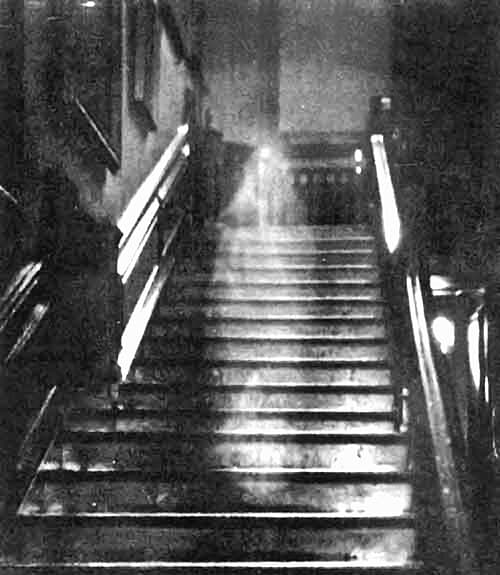
This is one of the most famous ghost photographs ever published. It was taken at Raynham Hall in Norfolk on 19 September 1936 by Country Life photographer Captain Hubert C. Provand and his assistant Indre Shira while they were on assignment photographing the house. According to the story later published by Country Life on 26 December 1936, Shira saw a misty female figure descending the staircase and Provand quickly exposed the plate. The figure was soon identified in folklore as the “Brown Lady,” usually linked to Dorothy Walpole. The image later appeared in Life as well and became one of the defining examples of 20th century spirit photography.
Why it feels haunted
This image works because it does not fully show a person, but it absolutely suggests one. The shape is close enough to a body for the brain to register human presence, yet too vague to classify safely. That gap matters. When perception cannot resolve a figure, the mind does not stay neutral. It starts testing possibilities, and one of the oldest possibilities is threat.
The staircase also does a lot of psychological work. Stairs imply movement, transition, and approach. A figure halfway on a staircase feels more active than a figure standing still in a room. It looks like something is on its way toward the viewer.
Psychology behind it
The strongest effect here is agent detection. Humans are primed to assume a human or human like presence from limited cues, especially in dim or incomplete visual conditions. There is also pareidolia, because the soft blur encourages the brain to convert vague tonal information into a recognizable form. The final ingredient is context framing. Once viewers know the image was taken in an old country house already associated with ghost stories, the photograph stops being a blur on stairs and becomes evidence inside a narrative.
2. The Tulip Staircase Ghost, Queen’s House, Greenwich
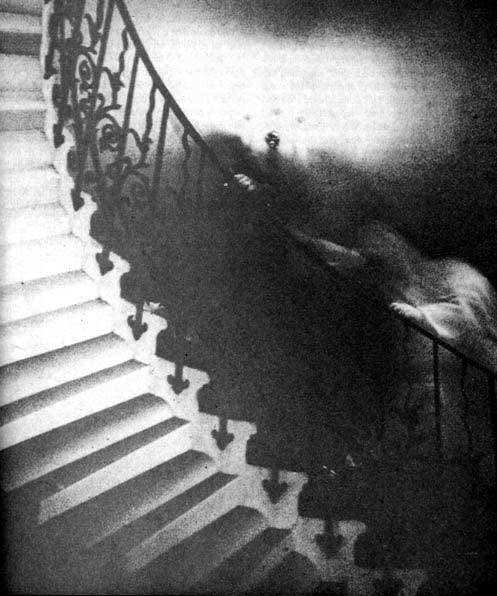
In 1966, retired Canadian Reverend R. W. Hardy and his wife visited the Queen’s House in Greenwich and photographed its famous Tulip Stairs. According to Royal Museums Greenwich, the strange shrouded figure was not noticed at the time of the visit but appeared only after the film was developed. The museum notes that on closer inspection the image seems to show a figure ascending the stairs, possibly with additional forms behind it. The photograph became so well known that it later attracted an overnight investigation by members of the Ghost Club in June 1967, although that vigil produced no conclusive evidence of the paranormal.
Why it feels haunted
This photo has a different emotional texture from the Brown Lady. Here the architecture is cleaner, brighter, and more geometric, which makes the figure feel even more intrusive. The staircase should look elegant, airy, and controlled. Instead, a dark, draped form seems to interrupt that order.
The image also creates tension through shape. It does not clearly show a face, which makes the figure feel less like a person and more like a presence. A fully readable human face can sometimes reduce fear because it gives the viewer social information. A hidden face does the opposite.
Psychology behind it
This is a strong example of the uncanny effect. The form appears human, but not in a complete or emotionally readable way. The brain sees a body without the normal cues that make bodies feel socially safe. There is also a violation of expectation. A historic staircase invites aesthetic appreciation, not threat. When a seemingly human form appears where viewers expect emptiness and symmetry, the mismatch creates unease. The image is memorable because it contaminates an orderly scene with unresolved presence.
3. The Cooper Family Falling Body Photo
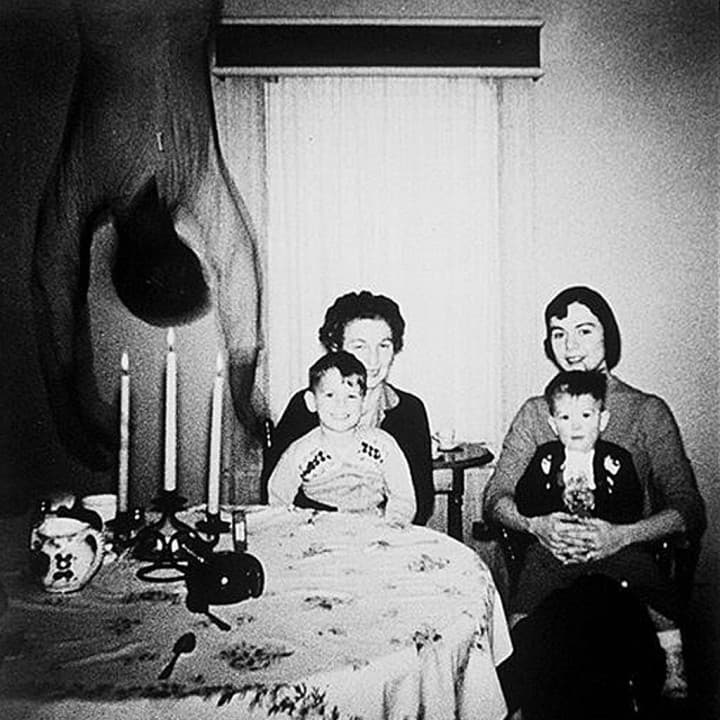
For years this image circulated online with a horror story attached to it. It was usually presented as an old family photo, often said to be from Texas in the 1950s, showing two adults and two children seated at a table while an upside down body or hanging figure appears above them. The image developed a reputation as one of the internet’s creepiest “haunted family photos.” But in a later post on Studio Ramsdell, the artist behind the image wrote that he created it in the darkroom in the early 1980s after a disturbing dream, using found family snapshot negatives to create images where ordinary people seemed oblivious to looming danger. He also said he was shocked to discover in May 2015 that the picture had spread online as a meme with a fabricated Cooper family backstory.
Why it feels haunted
Even once you know it is constructed, the image still works. In some ways it works even better, because it reveals how little it takes to poison a familiar scene. Family photos are supposed to feel safe, warm, and socially legible. Everyone is posed. Everyone is visible. The home is meant to function as a zone of control.
The suspended body destroys that certainty instantly. It introduces an impossible vertical element into an image built around domestic order. The viewer’s eye keeps returning to it because it does not belong, yet it is placed just naturally enough to feel fused into the scene.
Psychology behind it
This image shows the power of schema violation. A schema is the mental template we use to understand a scene. A family dining photo has a very stable schema: parents, children, table, posed calm. The hanging figure violates that template so hard that the whole image becomes corrupted. There is also threat intrusion at work. One impossible detail can rewrite the emotional meaning of the entire frame. This is why creepy edits of normal photos are often more effective than overt horror art. They invade the ordinary rather than announcing themselves as fiction.
4. The Freddy Jackson Squadron Photo
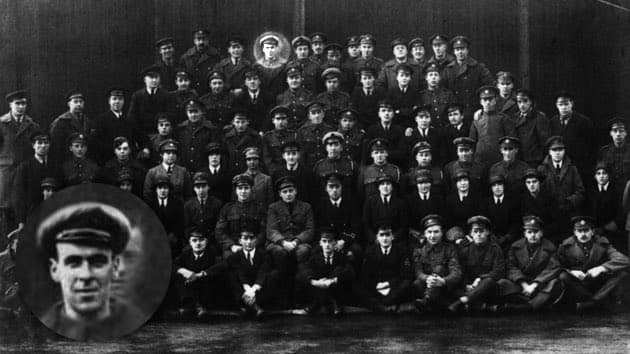
This image is usually presented as a Royal Air Force squadron photo taken in 1919. The story attached to it says that one mechanic, Freddy Jackson, had been killed by an aircraft propeller shortly before the group portrait, and that his face later appeared behind one of the living squadron members. Wikimedia Commons describes the image as a 1919 group portrait first published in 1975 by retired RAF officer Sir Victor Goddard. Over time, the “ghost face” interpretation became the central reason the image circulated in paranormal books, websites, and forums.
Why it feels haunted
This image is quieter than the others. There is no blur, no staircase, no dramatic apparition. What makes it disturbing is that the alleged ghost face is half buried within a formal group portrait. The image invites a second look, then a third. Once the face is pointed out, the photograph changes permanently.
This is a classic haunted image structure: the fear comes not from spectacle but from delayed recognition. At first the picture looks ordinary. Then one hidden detail reclassifies everything.
Psychology behind it
The main mechanism here is face detection bias. Human beings are extremely sensitive to faces, even partial ones. We detect them in shadows, clouds, stains, and low resolution noise. Once viewers are told where to look, the brain locks onto the pattern and the interpretation hardens. There is also story priming. If the viewer learns first that a dead man supposedly appeared in the photo, the face becomes emotionally charged before it is even inspected. Narrative enters perception and changes what the viewer sees.
5. The Solway Firth “Spaceman”
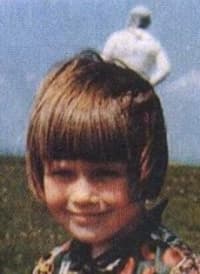
On 23 May 1964, Jim Templeton took three photographs of his young daughter on Burgh Marsh near the Solway Firth in Cumberland. Templeton later said he had not seen anyone standing behind her when he took the picture, but after development the now famous image appeared to show a pale human like figure in the background, which many people described as a spaceman or someone in a protective suit. The photo gained broad publicity, and Templeton said Kodak confirmed the image was genuine in the sense that the film had not been tampered with. Decades later, journalist David Clarke argued that the figure was most likely Templeton’s wife Annie, whose pale blue dress may have blown out to white because of overexposure and whose position from behind created the illusion.
Why it feels haunted
This one is not a ghost image in the classic staircase sense, but it belongs in the same family of visual unease. The child in the foreground makes the image feel ordinary and personal. The mysterious figure in the background breaks that safety. Because the figure is distant and overexposed, it reads as both human and inhuman at once.
That combination is powerful. A clear person in the background might simply feel accidental. A distorted person can feel impossible.
Psychology behind it
This image depends on ambiguity under poor visual resolution. The brain tries to identify a distant human shape with almost no reliable detail. Under those conditions, perception overweights silhouette and contrast. That leads to exaggerated interpretations. There is also meaning inflation through context. Once newspapers and later paranormal or UFO communities framed the figure as a mystery, viewers stopped seeing “possible overexposed bystander” and started seeing “entity.” The image demonstrates how a weak visual signal can become culturally powerful when paired with a suggestive story.
What all five images have in common
These images look different, but they all use the same underlying formula. They suggest human presence while withholding certainty.
That formula is almost perfect for fear because the brain is highly sensitive to signs of agency. We want to know who is there, what they want, and whether they are a threat. If an image gives us just enough to trigger that question, but not enough to answer it, the mind keeps working after the image is gone.
Across all five cases, the recurring mechanisms are:
Pareidolia
We turn vague shapes into meaningful forms, especially faces and bodies.
Agent detection
We assume intention and presence quickly, especially in uncertain conditions.
The uncanny effect
Things that look nearly human but not quite right feel disturbing.
Context priming
A title, legend, or famous backstory changes what the viewer notices.
Schema violation
One impossible detail can contaminate an otherwise safe and familiar scene.
Final thoughts
The enduring power of haunted images has less to do with proof of the supernatural and more to do with the architecture of perception. A photograph can feel cursed, watched, or wrong without containing anything paranormal at all. All it needs is ambiguity, a human shaped suggestion, and a story strong enough to push the mind in a fearful direction.
That is why these images stay alive. They do not simply show us something strange. They force us to watch the brain do what it does under uncertainty: detect, guess, narrate, and prepare for danger.
In that sense, the real haunting is not always in the picture.
Sometimes it is in the viewer.